

Quantum Field | Field, Superposition, Observation
Dates: March 29 (Sun) – April 21 (Tue), 2026
Open: Sunday, Monday, Tuesday | 11:00–17:00
Emerging in the early twentieth century, quantum mechanics exposed a radical proposition: objective reality does not pre-exist observation; rather, the world becomes determinate only through it. In dismantling the deterministic worldview of classical physics, quantum theory reconceived matter not as a fixed substance, but as a probabilistic state—collapsing into a single configuration only when observed. The observer is no longer external, but constitutive of the phenomenon itself.
Grounded in the concepts of superposition, the uncertainty principle, the measurement problem, and quantum field theory, quantum mechanics unsettled the metaphysical premise that reality consists of stable, self-contained entities. From the perspective of the dissolution of modern objectivism, this theoretical shift finds profound resonance within the field of contemporary art.
This exhibition repositions that ontological turn as a structural principle of artistic practice, bringing together works by Shinji Ogawa and neutral production.
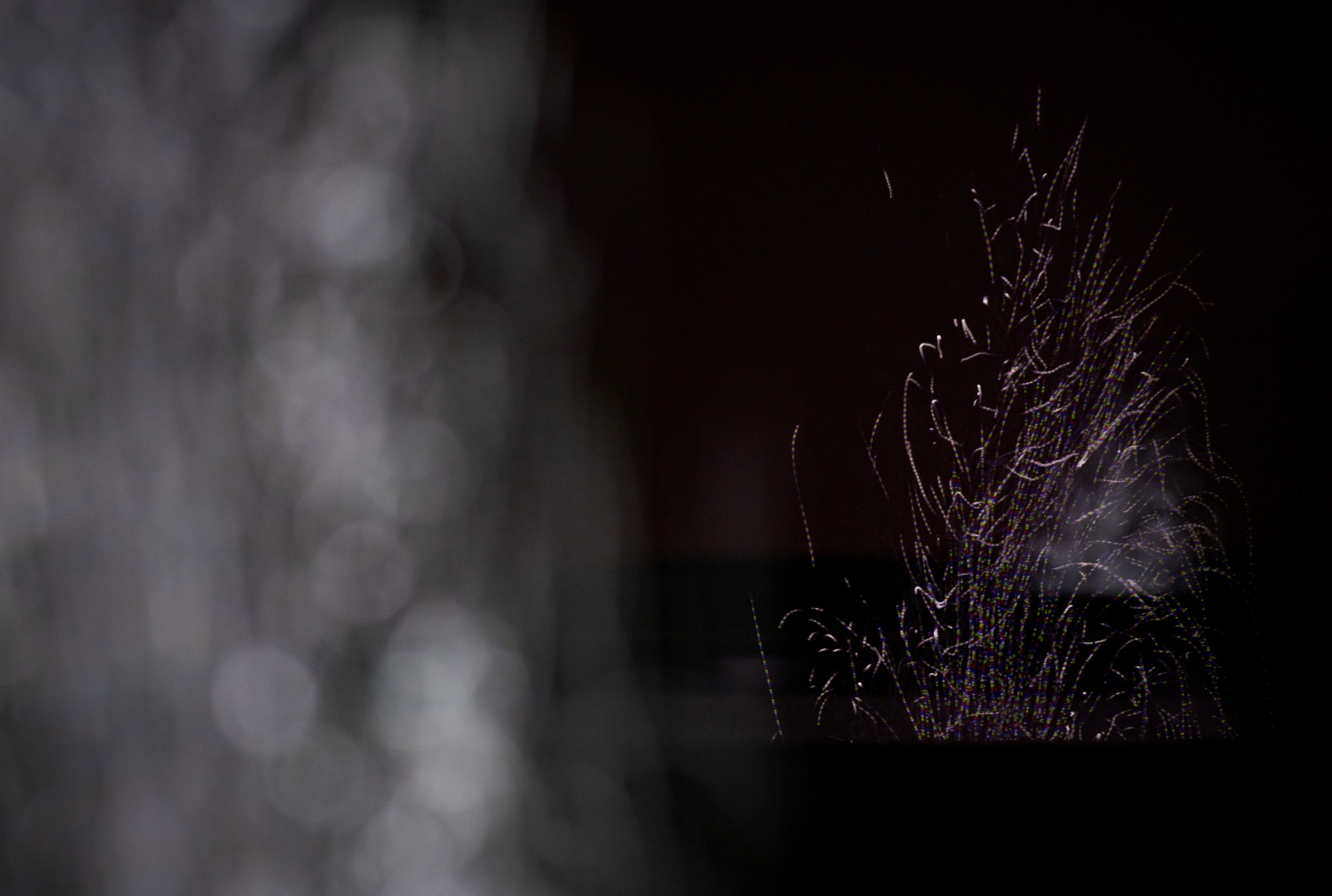
In Ogawa’s paintings, the image operates analogously to a wave function. While drawing upon photographic sources, he resists definitive representation. Dissolved contours, displaced focal points, and diffused light prevent the image from converging into a singular meaning. The painting here is not a completed icon but a state function containing multiple interpretive potentials. Through the viewer’s gaze—an act of observation—meaning is provisionally selected, yet never ontologically secured. This structure parallels the quantum condition of superposition, in which the wave function is projected into a particular eigenstate only upon measurement.
neutral production, by contrast, employs space itself as medium, dismantling the boundaries between artwork and environment, subject and object. Their installations are not fixed sculptural forms but states—modulated by light, circulation, and bodily movement. Just as quantum field theory understands particles as excitations of an underlying field, their spaces emerge as phenomena arising from relational dynamics rather than from discrete objects. Avoiding object-centered composition, the entire environment is conceived as a network of interactions in which light, material, movement, and perception interfere with one another. The work manifests not as an object, but as an event within a field. Framed by the ontological shift articulated in twentieth-century physics—particularly quantum mechanics and quantum field theory—this exhibition reconfigures the recognition that the world is not a collection of substances but a structure of interactions and probabilities.
Through meticulous painterly technique, Ogawa renders speculative “world lines”—alternative trajectories of reality. neutral production, projecting informational light onto physical particles, interrogates the raison d’être of existence itself. Through their respective modes of observation, the contours of what we call “reality” begin to waver.